
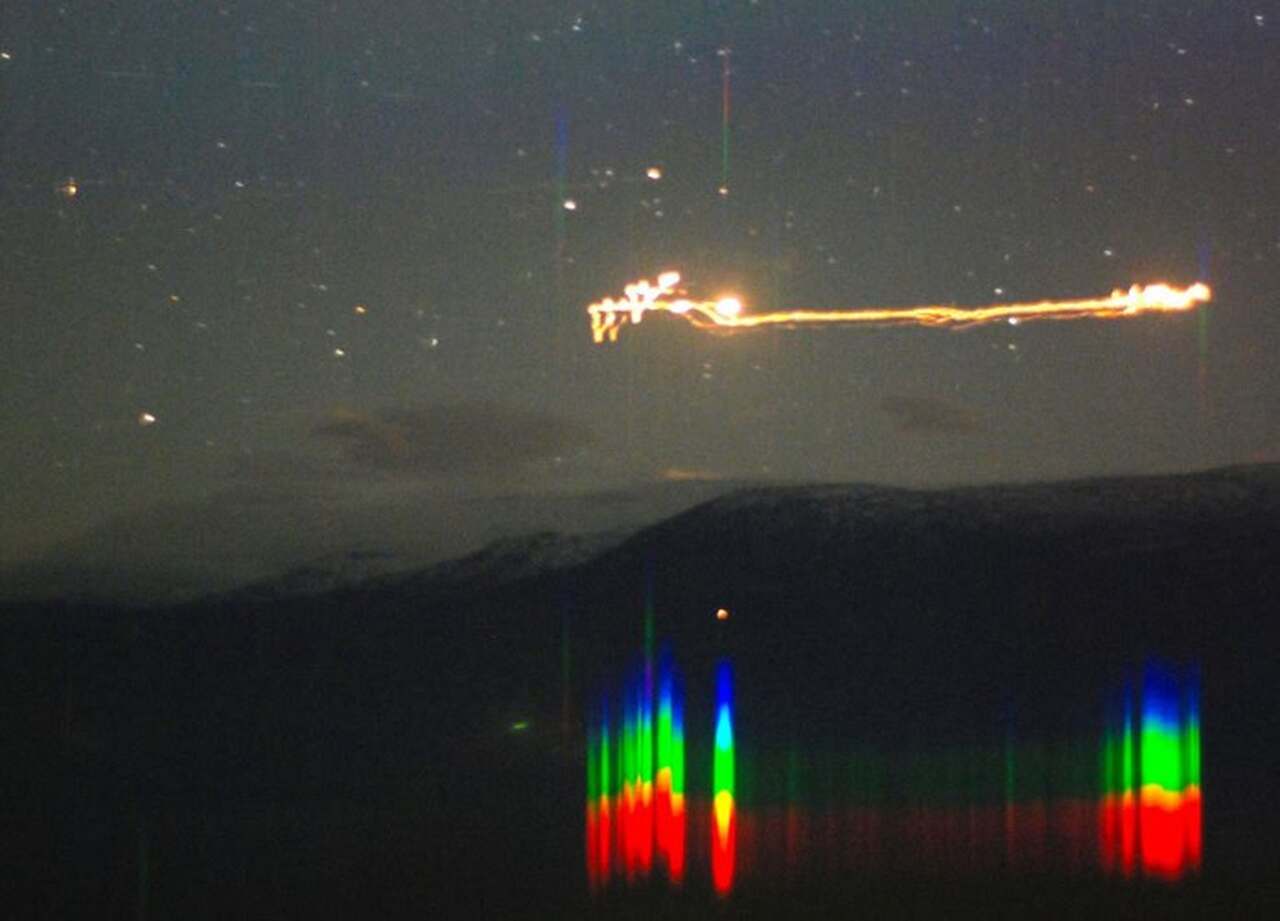
Mysterious lights have been recorded for decades in a small valley in inland Norway. Despite being mesmerizing, even scientists can’t say for sure what they are.
+ New photo of the Sun shows the solar surface “striae” for the first time
The curious phenomenon can be observed in the Hessdalen Valley, located 361 km from Oslo, the Norwegian capital. The lights are truly beautiful and attract many tourists, but even scientists can’t explain them.
According to an article published in the Journal of Applied Geophysics in July 2024, the first records of the phenomenon date back to 1811.
However, scientific investigations only began in 1984. In just the past 10 years, Østfold University College has been responsible for over 600,000 recordings of the lights.
The phenomenon is most common during winter nights in Hessdalen, and the colors of the lights vary between white and yellow, but they can also appear during the day, showing more metallic tones.
Researcher Bjorn Gitle from Østfold University College told the site NewScientist that the lights turn on “out of nowhere.” “When you see them, you can’t forget them,” he said.
The lights have been the subject of many theories, some involving alien activity and others involving a hidden battery beneath the ground of Hessdalen.
But since investment in research on the lights is still very low, scientists are still trying to figure out what they really are.
For Gitle, the battery theory — which emerged after a study by Jader Monari of the Institute of Radio Astronomy of Medicine in Italy, carried out in partnership with a scientist from the University of Bologna — is the most plausible.
If this is proven, science could open the door to energy storage through the lights. “If we have some kind of installation where we can trap charged particles inside, we could store energy,” Gitle argued.
Photo and video: Creative Commons. This content was created with the help of AI and reviewed by the editorial team.
