
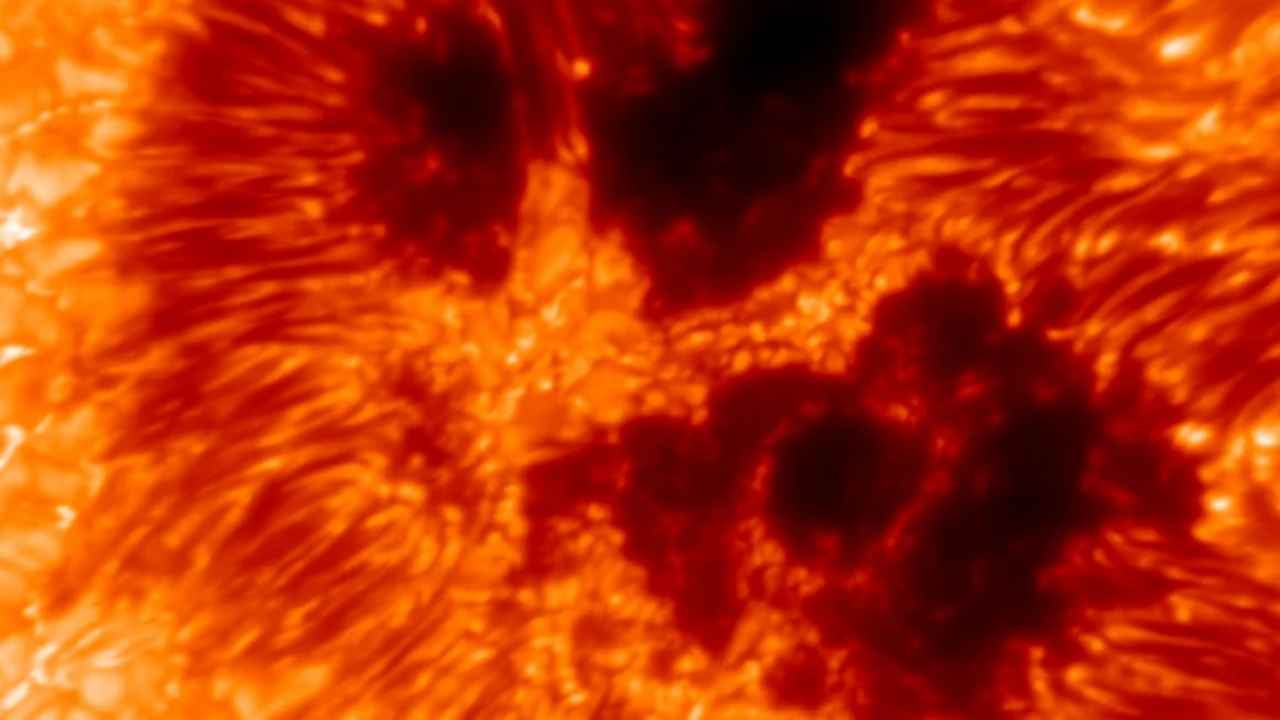
New image from the Inouye Solar Telescope provides an unprecedented view of the Sun’s complex activities, advancing our understanding of space weather
A newly released image of the solar surface, captured by the most powerful solar telescope ever built, offers an unparalleled view of the turbulent structure of our closest star.
This stunning image is the first taken with the new Visible Tunable Filter (VTF) of the Daniel K. Inouye Solar Telescope, operated by the U.S. National Science Foundation (NSF). The equipment allows for a detailed three-dimensional observation of phenomena occurring on the solar surface, according to an official statement.
The close-up shows a group of dark sunspots, the size of a continent, located near the center of the solar photosphere — the visible layer of the Sun. The resolution reaches an accuracy of 10 kilometers per pixel.
These spots indicate areas of intense magnetic activity, where solar flares and coronal mass ejections (CMEs) — massive clouds of plasma and magnetic fields emerging from the solar corona — are commonly found.
High-resolution captures like this one, taken in early December, are crucial for enhancing the understanding and prediction of space weather, explained Friedrich Woeger, an instrument scientist for the project. “Extreme events like the 1859 solar storm, known as the Carrington Event, caused fires in telegraph systems. We need to understand the mechanisms behind these occurrences and how they can impact our technological systems,” he said.
CMEs can interact with Earth’s magnetic field, affecting critical infrastructure such as electrical grids and satellite communication systems.
The Sun undergoes 11-year cycles of magnetic activity, alternating between periods of low and high intensity. In October, agencies like NOAA, NASA, and the International Solar Cycle Prediction Panel announced that the current cycle had reached its peak — the so-called “solar maximum.” During this phase, the Sun’s magnetic poles reverse, and sunspot activity increases.
With the solar maximum in progress, the Inouye Telescope has intensified image collection for instrument testing, taking advantage of the moment to capture spectacular records of solar dynamics.
How the Sun works from the inside
According to scientist Mark Miesch from the University of Colorado, although not directly involved in the research, the heat from the solar core spreads through convective motions, similar to the bubbling of soup on a stove.
Sunspots act as “magnetic obstructions” that hinder the release of heat. As a result, these regions appear darker — they emit less light and are relatively cooler than the rest of the surface, although still hotter than any terrestrial oven, Miesch says.
The Sun’s textured appearance is due to variations in temperature and density between its outer layers. The VTF allows these layers to be probed by filtering different wavelengths of light, functioning as a tuner that reveals what is happening at each level of the solar atmosphere.
This process is made possible by an etalon — two glass plates separated by micrometers — which uses the principle of wave interference, similar to the noise-canceling technology in headphones. The distance between the plates determines which wavelengths of light pass through and which are blocked.
In seconds, the VTF records hundreds of images at different frequencies, combining them into a three-dimensional model of solar activity. From this data, scientists can analyze variations in temperature, pressure, speed, and magnetic fields in different layers of the Sun.
“It was a surreal moment to see the first spectral scans. No other instrument on the telescope has this capability,” said Dr. Stacey Sueoka, optical engineer at the National Solar Observatory.
The future of solar observation
The development of the VTF took over a decade. Installed at the summit of Haleakalā, a 3,000-meter volcano in Maui, Hawaii, the spectropolarimeter occupies several floors of the Inouye Solar Telescope.
After being built in Germany by the Institute for Solar Physics, the instrument was transported across the Atlantic and Pacific Oceans and assembled piece by piece on-site, “like a ship in a bottle,” in Woeger’s words.
The VTF is expected to be fully operational by 2026.
“It can be said that the VTF represents the technological heart of the Inouye Telescope — and now it beats in its rightful place,” said Dr. Matthias Schubert, project scientist at the Institute for Solar Physics.
This initiative is part of a global effort to advance the understanding of the Sun, which also includes missions like the Solar Orbiter (from ESA and NASA) and the Parker Solar Probe — the first to literally ‘touch’ the Sun.
Source and images: CNN. This content was created with the help of AI and reviewed by the editorial team.
